
Cape York · Far North Queensland
Chasing Permit on the
Cape York Flats
A straight-talking guide to one of the wildest permit fisheries left on earth, written for visiting anglers who want to turn a look into an eat.
Permit have a way of making a good angler feel like a proper goose.
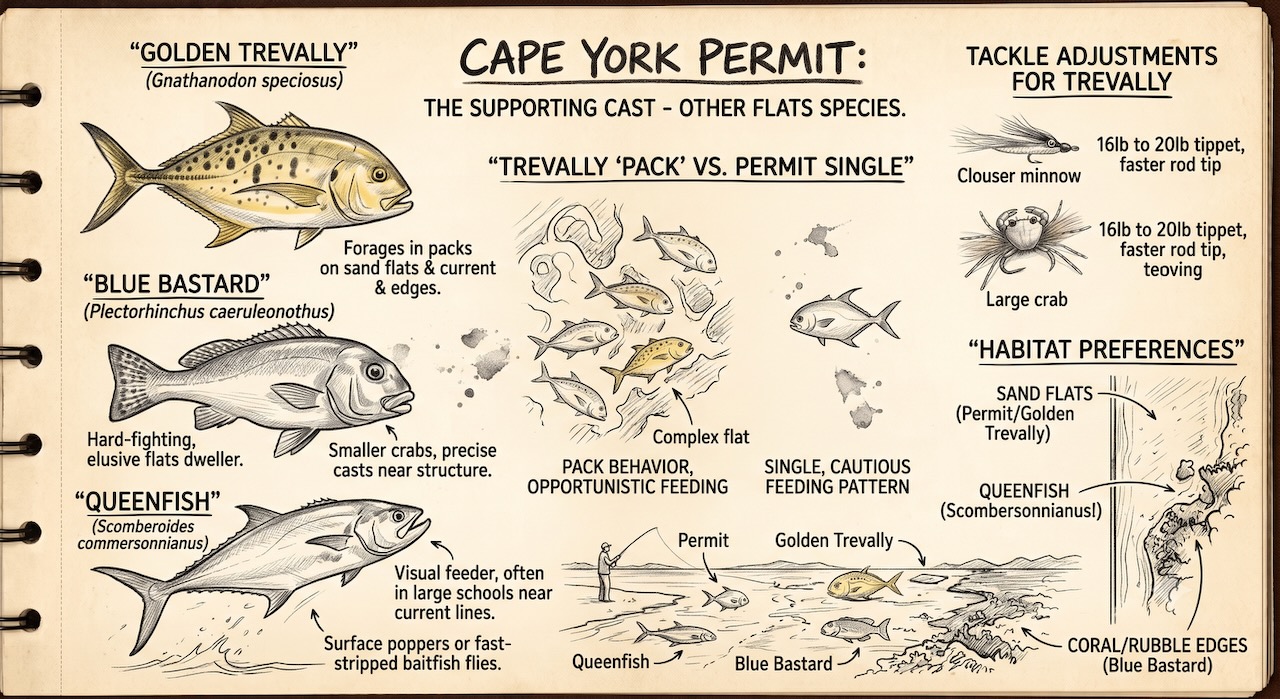
They are not impossible, but they are rarely forgiving, and up here on the top of Australia that is exactly what makes them worth the trip. The fish you will be hunting are not Florida Keys permit. These are Indo-Pacific permit, including the prized T. anak, sharing the flats with snubnose dart and a supporting cast of golden trevally, blue bastards and queenfish that will happily distract you all day.
The country is big and genuinely wild. Clear sand flats, coral edges, rubble patches, sandy drains and mangrove mouths, all sitting inside a tidal system that can turn over quickly. What follows is not theory. It is the practical stuff that decides whether you feed a fish or watch it slide off into the blue.
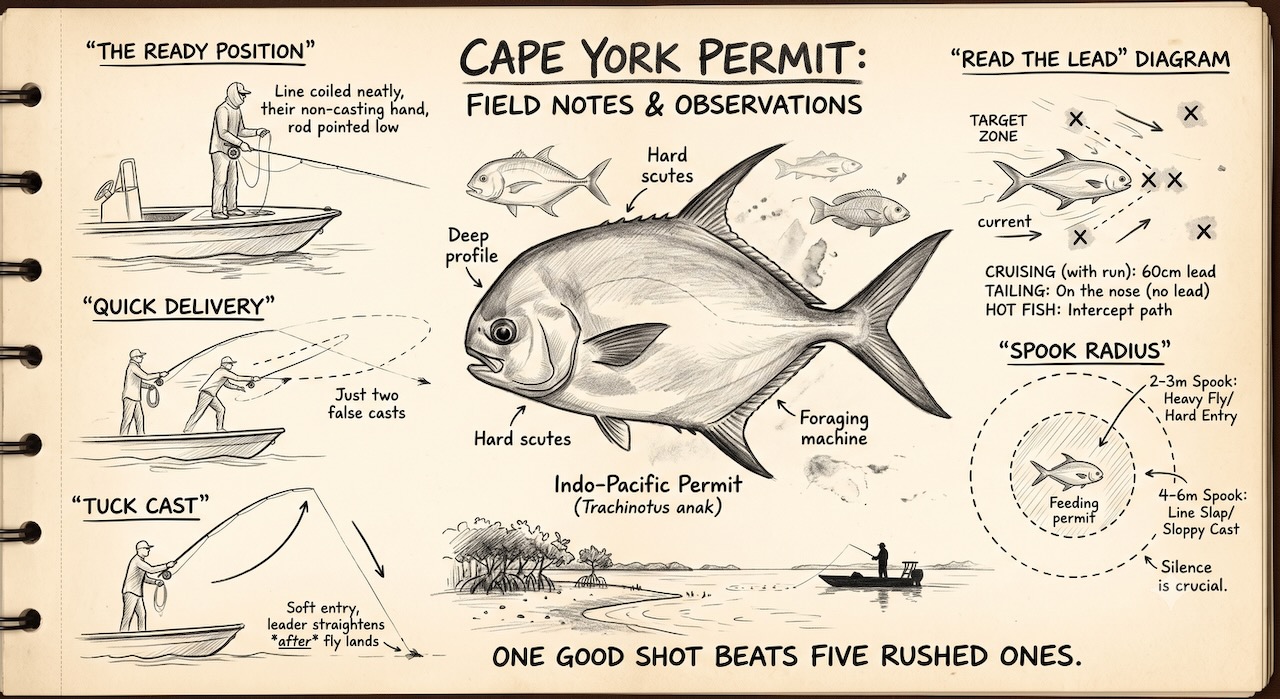 Field notes covering the basics: target species profile, cast delivery, and the critical spook radius.
Where It Actually Goes Wrong
Distance is not your real problem
Plenty of anglers turn up believing permit fishing is about launching eighty-foot lasers off the bow. It is not. In Cape York a clean forty to fifty-foot shot, put in front of the fish quickly and quietly, will out-fish a big cross-run cast almost every time. The fish are usually on the move, the boat is moving, and the wind is doing something awkward. Your window is short.
“Here is the thing worth burning into memory: most fish that get away do not get away because the cast was too long or too short. They get away in the last few seconds, after the fly has landed, at the stages nobody practises. The cast is the easy bit. Everything that happens next is where permit are won and lost.”
The One Skill Worth Drilling at Home
Hit a dinner-plate target at fifteen metres (about fifty feet) in two or three false casts from the ready position. Not from a standing start, from ready, with the fly already in your hand. Get that grooved and you will be streets ahead when a fish appears and starts walking.
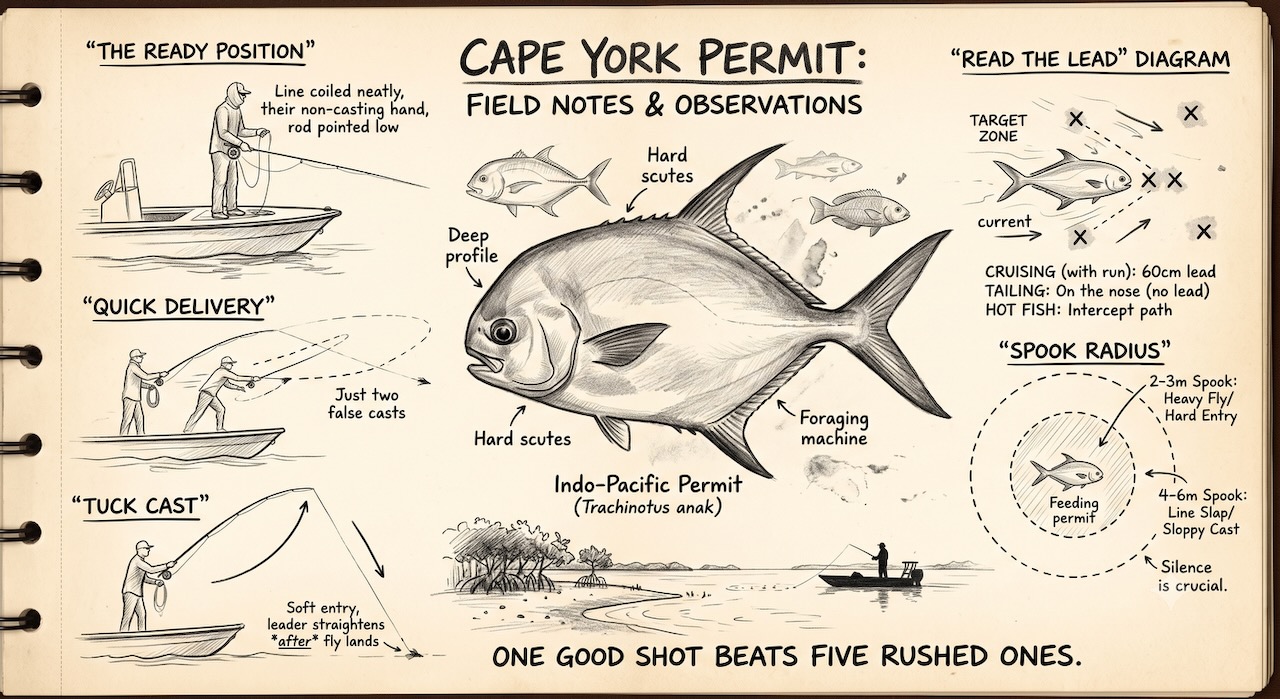
The Five Things That Matter
A permit shot, broken down. Every shot is really five small decisions stacked on top of each other. Get them in the right order and the odds swing your way.
Get it off fast, not far
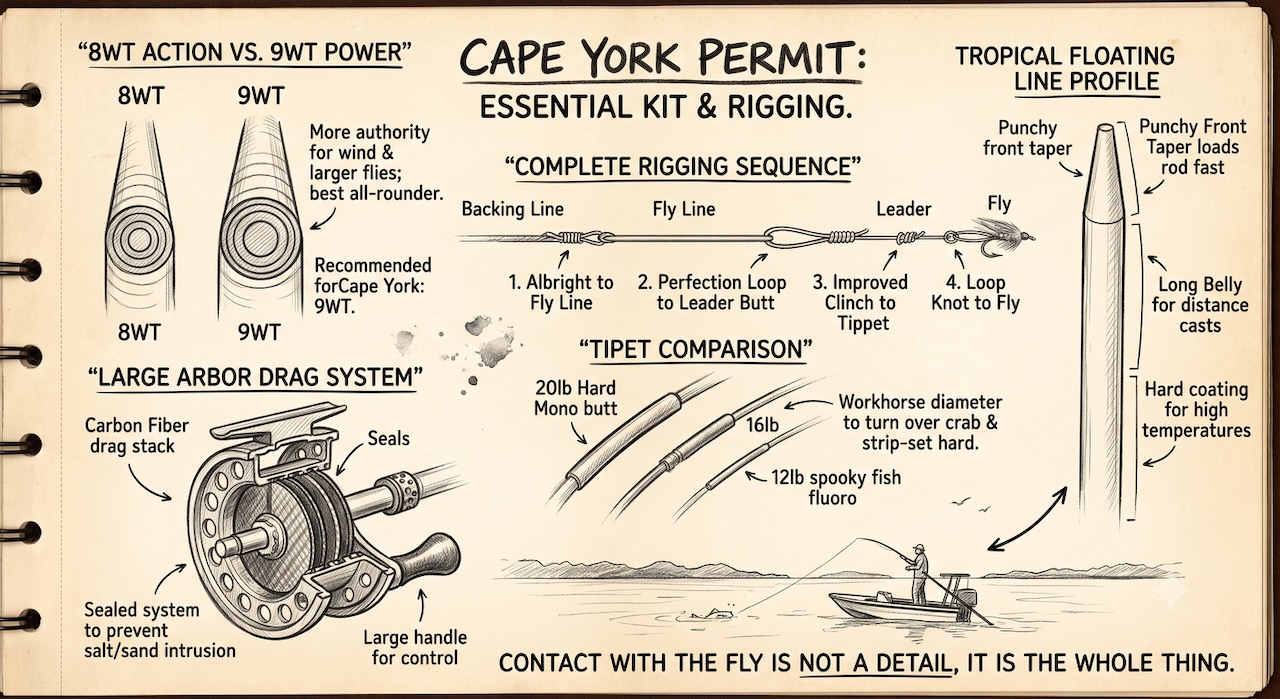
Fish a tropical floating line with a punchy front taper, the kind that loads the rod and shoots in a couple of false casts. Speed beats distance here. A fish that is cruising will not wait while you work out three more back-casts, so the angler who gets a decent fly in the zone first almost always beats the one still hunting for the perfect loop.
Lead the fish by reading it, not by a rule
The old book answer of a metre or so of lead (four to six feet) is only a starting point. The real lead depends on four things happening together: how fast the fish is travelling, which way the run is pushing, how quick your fly sinks, and the angle you are casting from. Read the fish first, then decide.
What works most days
| The Fish Is… | What to do with the fly |
|---|---|
| Cruising with the run | Drop it about 60cm to the side (two feet) and let the current swing it into their path. The fly simply appears in front of them, no splash, no warning. |
| Tailing on the bottom | Often no lead at all. Put it right in the feeding cone, that 30-degree window in front of the nose, and let it settle. Dead still or almost no movement. |
| Hot and aggressive | Drop it right in front, slightly ahead, so it looks like a feed trying to bolt. A fired-up fish will chase. |
Land it soft, land it clean
You want the fly touching down first, or level with the leader tip, and the fly line settling last and quietest. A tuck-style delivery does this well. The silent killer is the leader straightening past the fish and dropping the line across its back. That flushes them every time.
Move the fly, or don’t, but stay in touch
For cruising fish, short strips of 10-20cm with pauses. For a tailer, let it sink and leave it. Prawn patterns are the exception, needing life. But here is the critical part: stay in touch with the fly.
If there is slack between your line hand and the fly you cannot feel a take. A drifting hull with no stern anchor, add a bit of wind, and slack piles up. That is often what a last-second refusal really is: the fly quietly stopping behaving naturally.
“I had a day on the Tiwis recently… loaded with big feeding permit. Multiple genuine follows, then last-second refusals, six fly changes, tippet changes, and not a single eat. A slice of the problem was staying in touch. The boat drifting in the wind after each presentation put slack in the system at the worst possible moment. A reminder that contact with the fly is not a detail, it is the whole thing.”
The one that costs the most fish
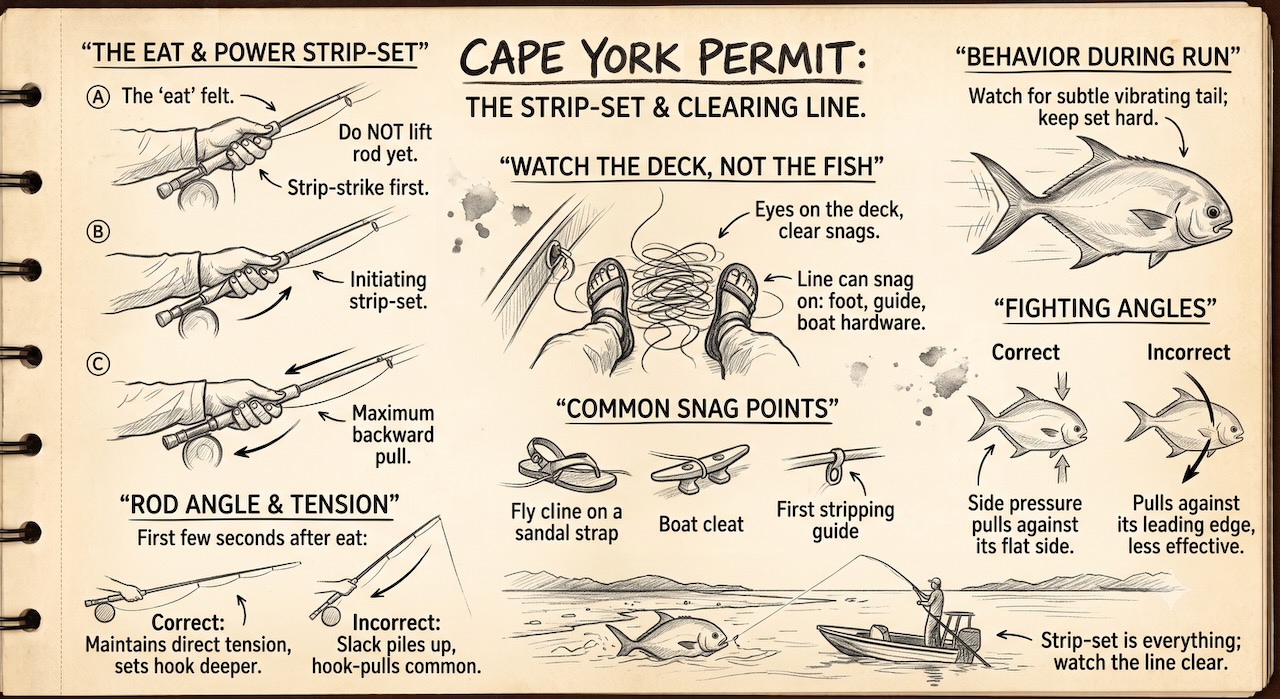
More permit are lost here than anywhere else, even after a good eat. Once you strip-strike you will have 3 to 5 metres of loose line piled on the deck that has to clear through the guides without snagging. Strip-set first, eyes on the line while it clears, then lift.
Kit That Suits The Country
Rods, leaders and the practical stuff
The Rod
An 8 or 9-weight. A 9 is usually the better all-rounder for Cape York, giving a bit more authority in a breeze and around mixed flats country.
The Leader
Around 2.7m (9ft) as your everyday setup. Built with the heavy butt section at roughly half the total length so it carries energy and turns a crab over.
Butt Section
40 lb hard mono or fluoro to drive the turnover and prevent the leader from piling up on the cast.
The Tippet
16 lb fluorocarbon is the workhorse. Not for leader-shyness, but so you can strip-set hard on a heavy crab. Drop to 12lb for spooky fish, up to 20lb for big models.
Conditions Tweak
On rare glass-calm days you can run longer, 4 metres plus (13-14ft). When it is blowing, keep it shorter; it turns over better and casts easier.
⚠️ Spook Radius, Worth Knowing
A hard-landing fly near a shallow tailer can put it down from 2-3 metres away (6-10 feet). Line slap from a sloppy entry does it from twice that. A line dropped straight across the back flushes the fish full stop. Soft and clean is not a nicety here, it is the whole game.
The Right Head on Your Shoulders
Don’t flog the water
Permit do not reward repeat bad casts, heavy presentations or flies landing on their heads. If the fish has not seen the fly properly, or the angle has gone wrong, reset rather than keep throwing. The best permit anglers are calm. They listen to the guide, they keep their line clear, they make the cast when it is asked for, and they do not try to turn every fish into a panic.
When the guide calls it, listen closely. “Two o’clock, forty feet, moving left” is not an invitation to false cast six times and drop the fly somewhere in the postcode. It is an instruction to put a controlled cast on a spot. Direction, distance and speed all matter.
“One good shot beats five rushed ones, every single time.”
What A Good Day Looks Like
Honest expectations
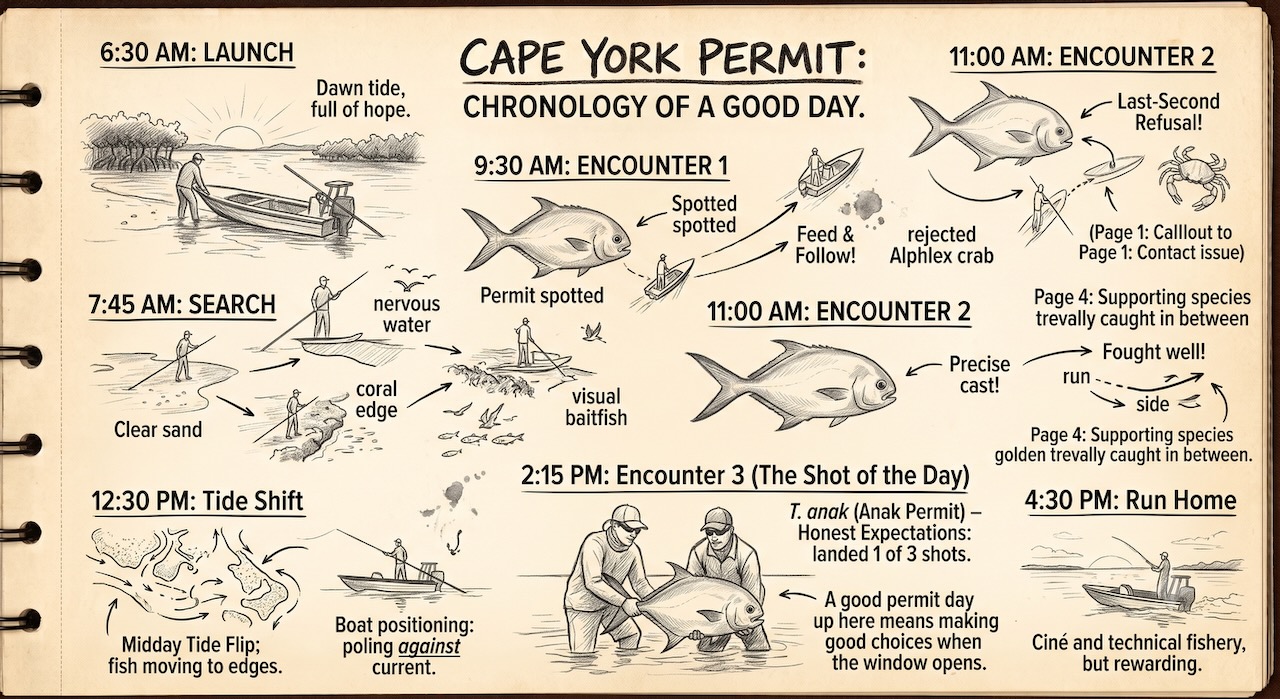
For anglers used to bonefish, tarpon and Keys permit, Cape York feels different. The fish are wild, the water is big, and the whole place feels far less managed. Fewer boats, fewer people, more moving parts. It is technical, but it is not impossible, and the anglers who do best are almost never the ones with the longest cast. They are the ones who adapt fastest.
A good permit day here may not mean six fish on the deck. It may mean seeing several good fish, getting two or three genuine shots, feeding one, and maybe landing the fish of the trip. That is permit fishing. It is demanding, occasionally brutal, and about as rewarding as fly fishing gets. When the window opens on the right flat at the right tide, you want to already be ready to convert.
Quick Answers We Get Asked
The common questions from visiting anglers
Most of the fish you will actually feed sit in the 10 to 18 metre window (35 to 60 feet), with 15 metres (50 feet) as the everyday working distance. A clean shorter head-on shot beats a long cross-run cast. Getting it there accurately in two or three false casts matters far more than maximum range.
It depends on the fish. For fish moving with the run, a small side lead of around 60cm and letting the current do the work is best. For tailers, put it on the nose with little to no lead. For a hot fish, drop it right in front like an escaping feed. Start with the old metre-and-a-half idea and adjust to the day.
16 lb fluorocarbon is the standard workhorse. It is less about the fish being leader-shy and more about turning over a heavy crab and setting hard without busting off. Go to 12 lb only for very spooky or smaller fish, and 20 lb for bigger fish or extra insurance.
Usually not much, if at all. Their eyes are down in that feeding cone, and a crab that drops in and stops is what they inhale. Strip it too soon and it leaves the zone. Cast, sink, maybe one little check strip, then let it sit. Prawn patterns are the exception.
Nine times out of ten it is contact, not the fly. If there is slack between your line hand and the fly, it stops behaving naturally right as the fish is deciding. A drifting boat with a bit of wind is the usual culprit. Start managing slack the instant the fly lands.
Line management after the eat. You have loose line on the deck that has to come up clean. Strip-set first, eyes on the line while it clears, then lift. Simple in theory, easy to stuff up when the adrenaline hits and you watch the fish instead of your line.